The query has to be between 2 and 50 characters

Advertisement
Advertisement

Current catalogue Flight Center - Valid from 01.04 to 31.05 - Page nb 20

Advertisement
Advertisement
Advertisement
Advertisement
Catalogue Flight Center 01.04.2022 - 31.05.2023
Advertisement
Advertisement
Advertisement

Products in this catalogue

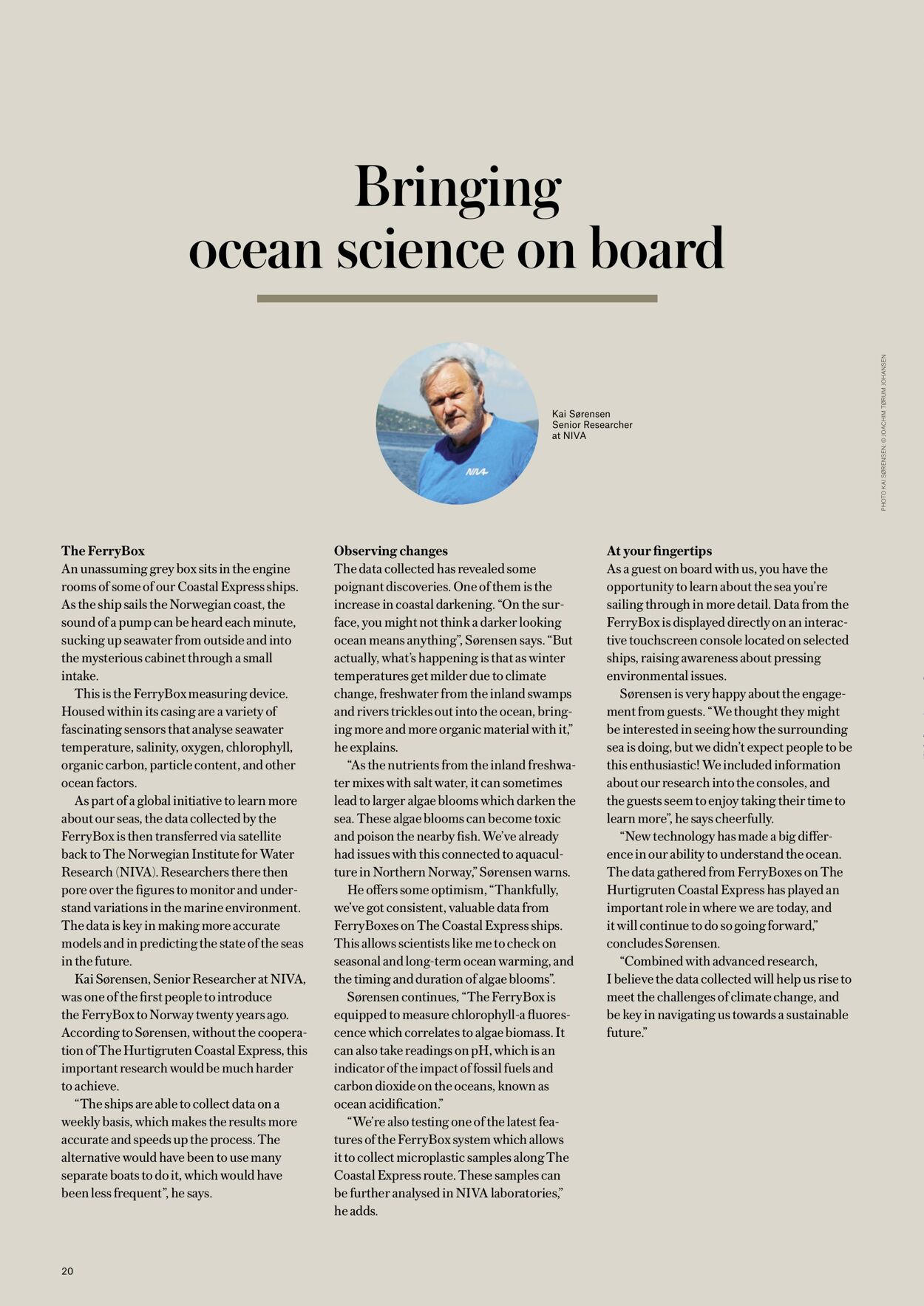
Bringing ocean science on board The FerryBox Anunassuming grey box sits in the engine rooms of some of our Coastal Express ships. As the ship sails the Norwegian coast, the sound ofa pump can be heard each minute, sucking up seawater from outside and into the mysterious cabinet through a small intake. Thisis the FerryBox measuring device. Housed within its casing are a variety of fascinating sensors that analyse seawater temperature, salinity, oxygen, chlorophyll, organic carbon, particle content, and other ocean factors. As part ofa global initiative to learn more about our seas, the data collected by the FerryBoxis then transferred via satellite back to The Norwegian Institute for Water Research (NIVA). Researchers there then. pore over the figures to monitor and under- stand variations in the marine environment. The data is key in making more accurate models and in predicting the state of the seas in the future. Kai Sorensen, Senior Researcher at NIVA, was one of the first people to introduce the FerryBox to Norway twenty yearsago. According to Sorensen, without the coopera- tion of The Hurtigruten Coastal Express, this important research would be much harder toachieve. “The ships are able to collect dataona weekly basis, which makes the results more accurate and speeds up the process. The alternative would have been to use many separate boats to doit, which would have beenless frequent”, he says. Kai Sorensen Senior Researcher it NIVA, Observing changes The data collected has revealed some poignant discoveries. One of them is the increase in coastal darkening. “On the sur- face, you might not think a darker looking ocean means anything”, Sorensen says. “But actually, what's happening is that as winter temperatures get milder due to climate change, freshwater from the inland swamps and rivers trickles out into the ocean, bring- ing more and more organic material with it,” heexplains. “As the nutrients from the inland freshwa- ter mixes with salt water, itcan sometimes lead to larger algae blooms which darken the sea. These algae blooms can become toxic and poison the nearby fish. We've already had issues with this connected to aquacul- ture in Northern Norway,’ Sorensen warns. He offers some optimism, “Thankfully, we've got consistent, valuable data from FerryBoxes on The Coastal Express ships. This allows scientists like me to check on seasonal and long-term ocean warming, and the timing and duration of algae blooms’. Sorensen continues, “The FerryBox is equipped to measure chlorophyll-a fluores- cence which correlates to algae biomass. It canalso take readings on pH, which is an indicator of the impact of fossil fuels and carbon dioxide on the oceans, known as ocean acidification” “We're also testing one of the latest fea- tures of the FerryBox system which allows itto collect microplastic samples along The Coastal Express route. These samples can be further analysed in NIVA laboratories,” headds. Atyour fingertips Asaguest on board withus, you have the opportunity to learn about the sea you're sailing through in more detail. Data from the FerryBoxis displayed directly on an interac- tive touchscreen console located on selected ships, raising awareness about pressing environmental issues. Sorensen is very happy about the engage- ment from guests. “We thought they might be interested in seeing how the surrounding sea is doing, but we didn't expect people to be this enthusiastic! We included information. about our research into the consoles, and the guests seem to enjoy taking their time to learn more’, he says cheerfully. “New technology has made a big differ- ence in our ability to understand the ocean. The data gathered from FerryBoxes on The Hurtigruten Coastal Express has played an important role in where we are today, and it will continue to do so going forward? concludes Sorensen. “Combined with advanced research, I believe the data collected will help us rise to meet the challenges of climate change, and be key in navigating us towards a sustainable future”

Latest catalogues

Catalogues selected for you

Advertisement
Bringing ocean science on board The FerryBox Anunassuming grey box sits in the engine rooms of some of our Coastal Express ships. As the ship sails the Norwegian coast, the sound ofa pump can be heard each minute, sucking up seawater from outside and into the mysterious cabinet through a small intake. Thisis the FerryBox measuring device. Housed within its casing are a variety of fascinating sensors that analyse seawater temperature, salinity, oxygen, chlorophyll, organic carbon, particle content, and other ocean factors. As part ofa global initiative to learn more about our seas, the data collected by the FerryBoxis then transferred via satellite back to The Norwegian Institute for Water Research (NIVA). Researchers there then. pore over the figures to monitor and under- stand variations in the marine environment. The data is key in making more accurate models and in predicting the state of the seas in the future. Kai Sorensen, Senior Researcher at NIVA, was one of the first people to introduce the FerryBox to Norway twenty yearsago. According to Sorensen, without the coopera- tion of The Hurtigruten Coastal Express, this important research would be much harder toachieve. “The ships are able to collect dataona weekly basis, which makes the results more accurate and speeds up the process. The alternative would have been to use many separate boats to doit, which would have beenless frequent”, he says. Kai Sorensen Senior Researcher it NIVA, Observing changes The data collected has revealed some poignant discoveries. One of them is the increase in coastal darkening. “On the sur- face, you might not think a darker looking ocean means anything”, Sorensen says. “But actually, what's happening is that as winter temperatures get milder due to climate change, freshwater from the inland swamps and rivers trickles out into the ocean, bring- ing more and more organic material with it,” heexplains. “As the nutrients from the inland freshwa- ter mixes with salt water, itcan sometimes lead to larger algae blooms which darken the sea. These algae blooms can become toxic and poison the nearby fish. We've already had issues with this connected to aquacul- ture in Northern Norway,’ Sorensen warns. He offers some optimism, “Thankfully, we've got consistent, valuable data from FerryBoxes on The Coastal Express ships. This allows scientists like me to check on seasonal and long-term ocean warming, and the timing and duration of algae blooms’. Sorensen continues, “The FerryBox is equipped to measure chlorophyll-a fluores- cence which correlates to algae biomass. It canalso take readings on pH, which is an indicator of the impact of fossil fuels and carbon dioxide on the oceans, known as ocean acidification” “We're also testing one of the latest fea- tures of the FerryBox system which allows itto collect microplastic samples along The Coastal Express route. These samples can be further analysed in NIVA laboratories,” headds. Atyour fingertips Asaguest on board withus, you have the opportunity to learn about the sea you're sailing through in more detail. Data from the FerryBoxis displayed directly on an interac- tive touchscreen console located on selected ships, raising awareness about pressing environmental issues. Sorensen is very happy about the engage- ment from guests. “We thought they might be interested in seeing how the surrounding sea is doing, but we didn't expect people to be this enthusiastic! We included information. about our research into the consoles, and the guests seem to enjoy taking their time to learn more’, he says cheerfully. “New technology has made a big differ- ence in our ability to understand the ocean. The data gathered from FerryBoxes on The Hurtigruten Coastal Express has played an important role in where we are today, and it will continue to do so going forward? concludes Sorensen. “Combined with advanced research, I believe the data collected will help us rise to meet the challenges of climate change, and be key in navigating us towards a sustainable future”

Most popular catalogues

Advertisement
Advertisement

If you continue to browse this website, you accept the use of cookies.

Name Details